The internet has always promised connection, but for years, it delivered something closer to distance. Forums, chat rooms, and social platforms gave us ways to communicate, yet something essential was missing. Real-time human presence.
That changed dramatically with the rise of random video chat.
What started as a simple, almost chaotic experiment turned into a global phenomenon that reshaped how people meet online. And today, with the rise of AI-powered matching systems, we’re entering an entirely new phase of digital interaction.
The Birth of Random Video Chat
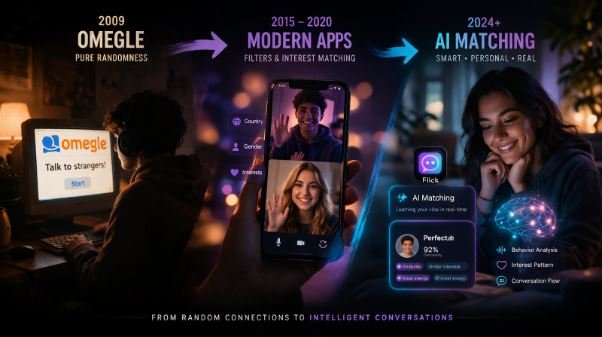
When Omegle launched in 2009, it introduced a concept that felt both strange and exciting. Talk to a complete stranger, instantly, without profiles, without expectations.
No follower counts. No curated feeds. Just two people connected by chance.
That unpredictability was the magic.
People didn’t join to build a brand or craft an image. They joined out of curiosity. Who will I meet next? Where are they from? What will they say?
For the first time, the internet felt spontaneous again.
Why Chaos Worked at the Beginning
Early random video chat platforms thrived on randomness itself. There were no filters, no smart systems, and very little control over who you would meet.
And surprisingly, that worked.
The unpredictability created excitement. Every connection carried a sense of possibility. Conversations were raw, unplanned, and often unforgettable.
But there was a downside.
Without moderation or intelligent matching, the experience could quickly become inconsistent. One moment you were having a meaningful conversation, the next you were skipping endlessly.
Users began to realize that randomness alone wasn’t enough.
The Shift Toward Structure and Safety
As random video chat grew, platforms started adding layers of structure.
Basic filters, reporting systems, and moderation tools became standard. The goal was simple. Keep the spontaneity, but reduce the chaos.
This phase marked an important transition.
Users were no longer just looking for randomness. They were looking for better randomness. More relevant connections. Safer environments. Less time wasted on mismatched interactions.
The expectation changed from “surprise me” to “surprise me, but make it good.”
The Rise of Smarter Matching
This is where the real evolution begins.
Instead of pairing users purely at random, platforms started experimenting with smarter ways to connect people. Interests, language, and behavior signals began to play a role.
It was no longer about who you meet, but how well you match.
This shift dramatically improved user experience. Conversations lasted longer. Engagement increased. People were more likely to return.
But even then, something was still missing.
Most systems were still rule-based. They relied on simple inputs rather than understanding real human behavior.
Enter AI Matching
The next leap forward came with artificial intelligence.
AI matching doesn’t just look at what you select. It learns how you interact. It understands patterns, preferences, and subtle signals that traditional systems miss.
It observes how long you stay in conversations. What kind of people you engage with. When you skip and when you don’t.
Over time, it builds a dynamic understanding of what a “good match” actually means for you.
This changes the entire experience.
Instead of endless skipping, connections start feeling intentional. Conversations become smoother. And the platform begins to feel less like a roulette and more like a discovery engine.
A New Generation of Platforms
This is where a new wave of video chat platforms is emerging.
Instead of focusing purely on randomness, they combine spontaneity with intelligence. The goal is not to remove surprise, but to refine it.
One example of this new approach is Flick.
Rather than leaving connections entirely to chance, Flick introduces an AI-driven matching layer that quietly works in the background. It learns from user behavior in real time and adjusts connections to create more natural, engaging interactions.
The result feels different.
You still meet strangers. You still don’t know exactly who’s next. But the conversations feel more aligned, more fluid, and far less frustrating.
It’s not about controlling the experience. It’s about improving it without breaking the magic.
Why AI Matching Feels More Natural
At first, the idea of AI deciding who you meet might sound artificial. But in practice, it often feels more human.
That’s because good conversations aren’t random in real life either.
We naturally gravitate toward people who share similar energy, communication styles, or interests. AI simply accelerates that process in a digital environment.
It reduces friction.
Instead of spending time filtering through mismatches, you spend more time actually talking.
And that shift makes the entire experience feel more real.
The Balance Between Randomness and Relevance
The evolution of random video chat isn’t about replacing randomness. It’s about balancing it.
Too much randomness leads to chaos. Too much control removes the excitement.
The future lies somewhere in between.
Platforms that succeed are the ones that preserve the thrill of meeting someone new while quietly increasing the chances that the connection will actually work.
This balance is what defines the next generation.
What Comes Next for Video Chat
We’re still in the early stages of AI-driven interaction.
As technology improves, matching systems will become even more refined. They’ll understand tone, behavior, and even conversational flow at a deeper level.
But the core idea will remain the same.
People don’t come to video chat platforms for algorithms. They come for connection.
The technology simply needs to get out of the way and make those connections better.
From Random to Meaningful
Looking back, the journey from Omegle to AI-powered platforms is more than just a technical evolution.
It’s a shift in how we experience online interaction.
What started as pure randomness is becoming something more intentional. More human. More meaningful.
And while the concept of talking to strangers hasn’t changed, the quality of those interactions is evolving fast.
Because in the end, it’s not about who you meet next.
It’s about how real that moment feels when you do.
About the Author